



Podcast
“Sovereignty Means Being Able to Change Course” – A Conversation with Manfred Beckers
Digital sovereignty in finance: Manfred Beckers discusses cloud dependencies, DORA, exit strategies and maintaining the ability to adapt.
Compliance


ACTICO Anti-Money Laundering detects suspicious payments, behavioural patterns, and anomalies in customer relationships. Cloud-first, AI-ready, and designed with flexible workflows, it offers banks, insurers, and financial service providers a modern and secure compliance environment. Compliance officers can generate suspicious activity data directly in the solution and upload the XML file to the FIU via goAML.
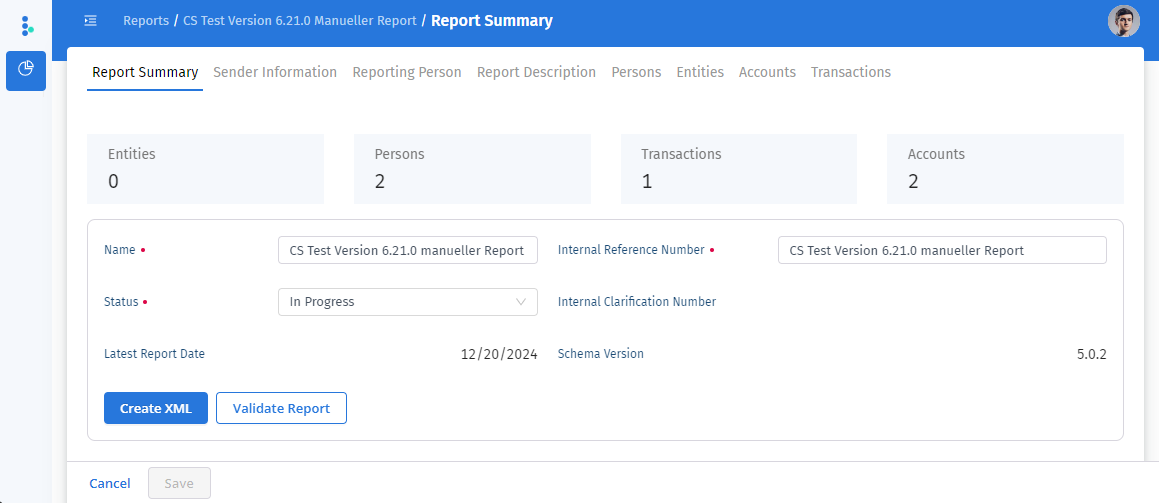
goAML is the reporting platform of Financial Intelligence Units (FIU or Swiss MROS) used for submitting suspicious activity reports related to money laundering. With the ACTICO FIU Reporting Solution, AML officers can generate the necessary data directly within ACTICO Compliance Solutions and upload the XML file to the FIU.
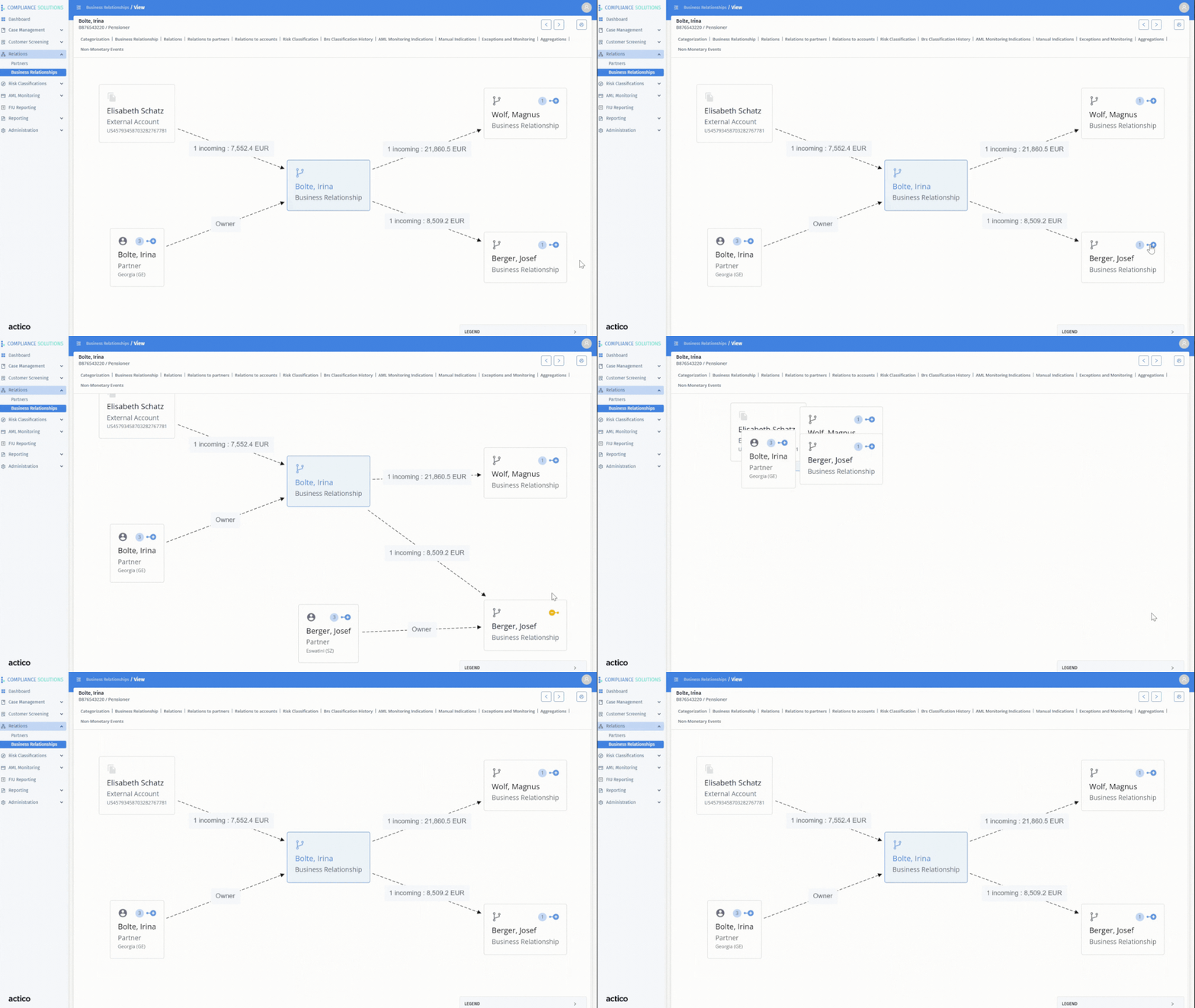
Visualising relationship networks clearly: ACTICOs graphical link analysis tool visually maps connections between partners, business relationships, watchlist matches, and transactions. This empowers Money laundering officers (MLROs) to quickly understand complex networks and trace hidden links.

Money laundering officers (MLROs) can access each case either via the dashboard or through the central worklist, which displays all open cases as well as a list of historical ones. Unusual transactions are handled through a structured investigation workflow. MLROs receive all relevant transaction details, along with clear explanations as to why a transaction was flagged as unusual.
During case processing, users can add notes, attach documents, and forward cases to colleagues for review. Based on this review, users can determine whether a suspicious activity report (SAR) should be submitted to the Financial Intelligence Unit (FIU).
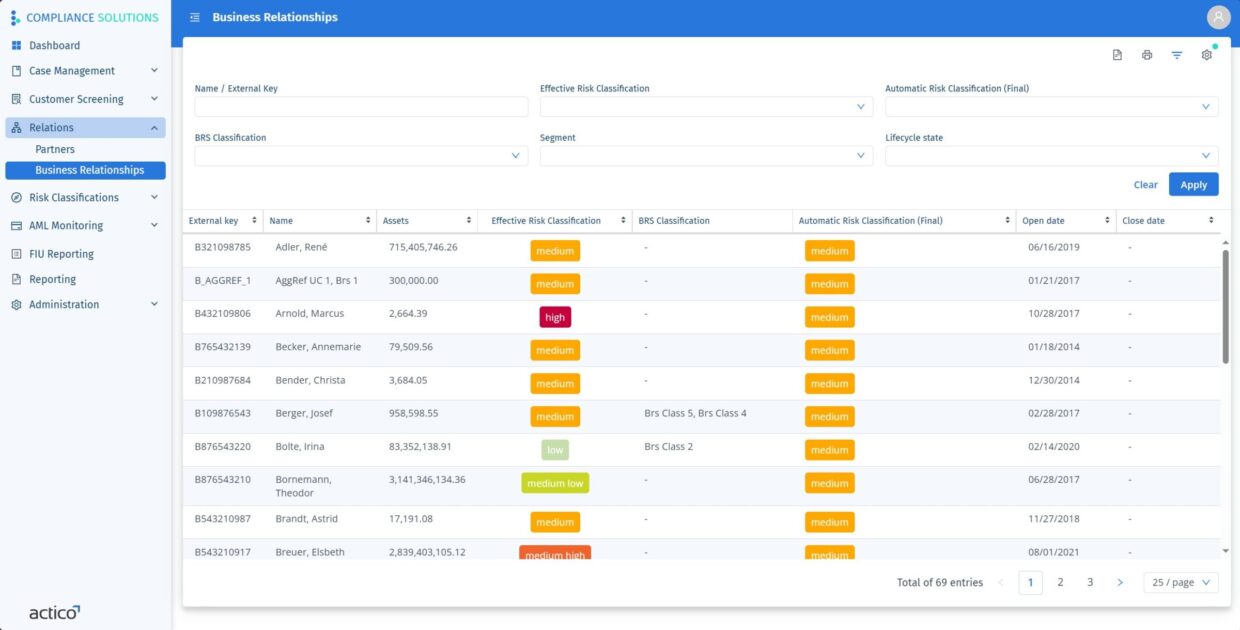
Benefit from tailored reporting with custom reports configured by your admins. Completed reports can be downloaded as CSV or spreadsheets, or printed as PDF with a single click. ACTICO Anti-Money Laundering also includes a suite of standard reports out of the box.
Money laundering scenarios in the insurance sector differ significantly from those in banking. Potential misuse of insurance policies — whether in new business, policy administration or the payout phase — can often be identified through patterns such as frequent early cancellations, unusually high top-up payments or changes to the policyholder.
An overview of typical insurance-related scenarios is available in our AML trend report.
How do business rules recognise suspicious transactions and patterns linked to money laundering?
Business rules in an AML system are pre-configured criteria used to monitor potential money laundering. Examples include limits on financial transfers, unusual money movements, and suspicious customer behaviour compared to a client’s normal pattern or that of their peer group.
ACTICO Anti-Money Laundering comes with a standard rule set to check transactions and personal data. When an anomaly occurs, the system notifies the money laundering officers and automatically initiates a workflow for further processing of these ‘hits’.
How can machine learning help reduce false positives in the AML process?
Machine Learning (ML) is a powerful method within artificial intelligence, particularly well-suited to reducing false positives in AML systems. ML models are trained using a combination of compliance officers’ expertise (expert knowledge) and historical money laundering cases (data knowledge). This complements the system’s rule-based verification algorithms, leading to improved detection performance by prioritising true positives over managing false alerts.
An ACTICO project with a retail bank demonstrated the significant potential of machine learning in reducing false positives in the fight against money laundering. A validation dataset showed that that bank eliminated approximately 40% of false positive alerts.
How does machine learning improve customer segmentation in AML?
Machine learning analyses customer data automatically, grouping customers into clusters based on behaviour, risk profile, and other factors. This reveals distinct segments and meaningful patterns—helping compliance teams focus where it matters most.
How does Generative AI support AML efforts?
Generative AI automates time-consuming research and regulatory reporting. For suspicious activity reports (SARs) to Financial Intelligence Units (FIU) or the Swiss Money Laundering Reporting Office MROS, GenAI extracts relevant information from complex datasets, evaluates findings, and generates structured drafts—dramatically reducing manual effort. AML experts simply prompt the AI to search data sources and produce a first draft. The result: faster, more accurate reporting.
What is important about risk classification in the AML process?
When calculating AML risks, various factors are taken into account—including customer risk (e.g. PEP status), product risk, transaction risk, country risk, and the risk associated with distribution channels.
Even broader sets of information can further enhance risk assessments. These may include partner details, business relationship structures, geographical data (such as countries of residence or nationalities), and external sources like customer screening results.
At ACTICO, business relationships are assigned a risk level based on these factors. While the risk level is generated automatically, it can be adjusted manually where needed. Key elements such as source of wealth, expected transaction volume, deposit levels, and the origin of assets can also be included. Users can easily define additional custom risk factors to tailor the model precisely to their needs. In exceptional cases, analysts can manually assign a specific risk classification.
ACTICO has consistently been recognized by customers and analysts as a leading provider of solutions for Compliance, Asset Administration, and Credit Risk Management, as well as Advanced Decision Automation Technology.






You may also be interested in:
Podcast
“Sovereignty Means Being Able to Change Course” – A Conversation with Manfred Beckers
Digital sovereignty in finance: Manfred Beckers discusses cloud dependencies, DORA, exit strategies and maintaining the ability to adapt.
Compliance

News
Chartis Research Again Names ACTICO a Category Leader for AML Transaction Monitoring 2026
ACTICO has again been named a Category Leader in the Chartis RiskTech Quadrant® for AML Transaction Monitoring Solutions 2026. The assessment recognizes ACTICO’s strengths in risk typology modeling, analytical modeling, model validation, workflow automation, and AI-powered compliance.
Anti-Money Laundering
Financial Institutions/FinTech, Insurance
Awards & Recognitions
News
ACTICO announces it has joined forces with Axe Finance, a global provider of credit and risk management software
ACTICO announces that it has joined forces with Axe Finance, a UK-based provider of credit and risk management software. The deal is supported by Keensight Capital, one of the leading private equity managers dedicated to pan-European Growth Buyout investments.

Webinar On-Demand
Update on AML Requirements for Insurers: what you need to do now to be ready by July 2027.
AML update for insurers: What needs to be done by July 2027 regarding KYC, risk assessment and transaction monitoring? Including practical insights. Watch the webinar.
Anti-Money Laundering
Insurance
Newsletter
Regular News and Updates
Compliance
Asset Administration
Credit Risk
Decision Management
Resources
You are currently viewing a placeholder content from Hubspot Embedded Content. To access the actual content, click the button below. Please note that doing so will share data with third-party providers.
More InformationYou are currently viewing a placeholder content from HubSpot. To access the actual content, click the button below. Please note that doing so will share data with third-party providers.
More InformationYou are currently viewing a placeholder content from Hubspot Meetings. To access the actual content, click the button below. Please note that doing so will share data with third-party providers.
More InformationYou are currently viewing a placeholder content from Wistia. To access the actual content, click the button below. Please note that doing so will share data with third-party providers.
More Information