

Podcast
“Sovereignty Means Being Able to Change Course” – A Conversation with Manfred Beckers
Digital sovereignty in finance: Manfred Beckers discusses cloud dependencies, DORA, exit strategies and maintaining the ability to adapt.
Compliance


01.09.2026|

AI agents are the next step in automation for the banking and insurance industries. At the same time, regulated financial institutions are subject to strict requirements for governance, human control, transparency, and auditability. These requirements cover the agents themselves, the language models they use, and the environments in which data is hosted. Data sovereignty therefore becomes a central consideration.
The EU AML package, along with rising expectations around transparency, risk analysis, and auditability, is increasing pressure on financial institutions and insurers. Compliance teams must analyze growing volumes of structured and unstructured data: from screening hits and transaction histories to adverse media information. This ties up resources and makes the shortage of skilled professionals even more acute.
Traditional rule-based compliance systems ensure consistent processes, review paths, and auditability. However, when it comes to complex relationships and large volumes of information, these systems often reach their limits. Analyzing complex relationships and large volumes of information can be automated only to a limited extent with fixed rules or rigid workflows.
For regulated institutions, dependence on global cloud and AI providers is a growing concern. Limited control, dependence on providers’ pricing models, and uncertainty about service availability are prompting financial institutions to consider alternatives. These include small, specialized LLMs (large language models) that run in their own data centers or on national or European infrastructure.
Processes involving substantial manual work, unstructured information, and time-consuming research are particularly well suited to automation with AI agents. One example is adverse media checks in customer screening. Other use cases include AML investigation support, FIU reporting, payment screening, regulatory analytics, and completeness checks.
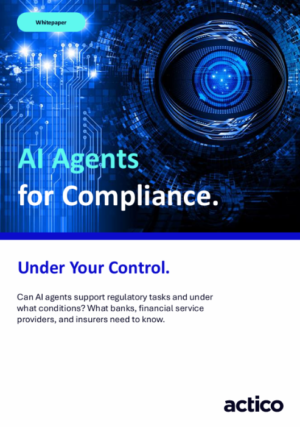
The whitepaper “AI Agents for Compliance” uses the example of adverse media research to show how AI agents work within ACTICO Compliance Solutions — from the screening hit and the review of regulatory relevance to the documented decision by the analyst. For a mid-sized bank, the whitepaper estimates efficiency potential of more than €500,000 per year.
ACTICO Compliance Solutions form the functional and regulatory core. They ensure governance, roles, permissions, review paths, and auditability. Within this framework, AI agents take over research, analysis, and documentation, and prepare decisions for review. What matters is that agents operate within clearly defined processes, with clear roles and permissions, and that final approval remains with people.
Behind every AI agent is a large language model that processes language and information. An AI agent combines the language model with defined tasks, roles, permissions, process steps, and control mechanisms. Together, these elements create a controllable digital assistant for compliance tasks.
ACTICO enables integration with general-purpose models from global hyperscalers. It also provides the AI architecture needed to run small, specialized LLMs in an organization’s own data centers or sovereign cloud environments. Because they specialize in compliance tasks, these models can be up to 100 times smaller and up to 50 times more cost-efficient to operate than general-purpose models.
The whitepaper examines in detail the trade-offs between cost, control, and data sovereignty. It also covers classification under the EU AI Act.
The Key Principles for AI in Compliance Management at ACTICO

“Only the controlled integration of agentic systems into existing regulatory processes, data, APIs, and governance structures enables modern agentic compliance,”
says Thomas Suchy, Executive Vice President Compliance Solutions at ACTICO.
Banks, insurers, and other financial service providers face the challenge of implementing regulatory requirements faster, more efficiently, and with greater control. Specialized AI agents can help them meet these demands.
ACTICO Compliance Solutions provide a field-tested, stable foundation for customer screening, payment screening, AML monitoring, case management and reporting. Agentic extensions reduce operational workload and make regulatory processes more efficient.
The key is combining standard software for regulatory compliance, governance, and specialized agentic support in a controlled way. The ACTICO AI architecture enables small, specialized LLMs optimized for specific compliance use cases to run in an organization’s own data centers or sovereign cloud environments.
The whitepaper walks through how AI agents can be integrated into existing compliance processes in a controlled way.
You may also be interested in:
Podcast
“Sovereignty Means Being Able to Change Course” – A Conversation with Manfred Beckers
Digital sovereignty in finance: Manfred Beckers discusses cloud dependencies, DORA, exit strategies and maintaining the ability to adapt.
Compliance

News
Chartis Research Again Names ACTICO a Category Leader for AML Transaction Monitoring 2026
ACTICO has again been named a Category Leader in the Chartis RiskTech Quadrant® for AML Transaction Monitoring Solutions 2026. The assessment recognizes ACTICO’s strengths in risk typology modeling, analytical modeling, model validation, workflow automation, and AI-powered compliance.
Anti-Money Laundering
Financial Institutions/FinTech, Insurance
Awards & Recognitions
News
ACTICO announces it has joined forces with Axe Finance, a global provider of credit and risk management software
ACTICO announces that it has joined forces with Axe Finance, a UK-based provider of credit and risk management software. The deal is supported by Keensight Capital, one of the leading private equity managers dedicated to pan-European Growth Buyout investments.

Webinar On-Demand
Update on AML Requirements for Insurers: what you need to do now to be ready by July 2027.
AML update for insurers: What needs to be done by July 2027 regarding KYC, risk assessment and transaction monitoring? Including practical insights. Watch the webinar.
Anti-Money Laundering
Insurance
Newsletter
Regular News and Updates
Compliance
Asset Administration
Credit Risk
Decision Management
Resources
You are currently viewing a placeholder content from Hubspot Embedded Content. To access the actual content, click the button below. Please note that doing so will share data with third-party providers.
More InformationYou are currently viewing a placeholder content from HubSpot. To access the actual content, click the button below. Please note that doing so will share data with third-party providers.
More InformationYou are currently viewing a placeholder content from Hubspot Meetings. To access the actual content, click the button below. Please note that doing so will share data with third-party providers.
More InformationYou are currently viewing a placeholder content from Wistia. To access the actual content, click the button below. Please note that doing so will share data with third-party providers.
More Information