Blog
FIU Reporting: Why Compliance Teams Are Getting Nervous – and How GenAI Can Help
Suspicious activity reports must be filed via goAML — incomplete or delayed submissions are no longer tolerated.
Financial Institutions/FinTech

24.07.2022|

Below you’ll find answers to your questions about business rules (FAQs), where we provide helpful explanations for anyone who wants to dig into the topic.
The “rule” factor in a rule-based engine represents a set of conditions, i.e., the system logic, followed by actions. Therefore: Rule = Condition + Action. Meaning, it’s an algorithm or flowchart that determines which actions or decisions should result based on certain conditions and data.
Online businesses transact hundreds and thousands of customer queries at any given time. With such volumes of information moving through a company’s portal, the best way to process business rules that govern these transactions is with computer programs rather than through human effort.
These computer programs are referred to as rule-based engines and are designed to input business rules into customer transactions. Rule-based engines use a graphical editor to automate and execute business rules and are reprogrammable by the IT department or authorized employees from other departments.
A rule-based engine is a software application that interacts with databases to gain access to business rules set by the Company’s employees and execute them whenever other applications request them. The application runs rules found within a database, and if any condition matches, it proceeds to perform the respective conditions.
A rule-based engine is programmed like any other software and primarily uses the Java language. They’re typically translated into program code and executed using a graphical editor for the rules to run as expected.
With recent technological advancements, rule-based engines can develop and train AI models and use AI and machine learning to support decisions in an organization.
A rule-based engine works in conjunction with ERP, banking, and insurance applications to execute their business rules during customer transactions.
Solid business rules engines are determined by how fast and accurate the application runs the conditions you set for the application. In particular, these are the characteristics of a well functioning rule engine:
The ACTICO Platform fulfills the criteria above and goes further to offer clients scalable software that combines rule-based engine technology with machine learning capabilities. Our software allows companies to process large amounts of data while making rule-based decisions in real-time.
Examples of business rules look like “If there have been credit defaults in the last five years, then he cannot take out an insurance policy with us” or “If the customer has processed more than three insurance claims in the last three years, then he will be offered conditions XYZ.”
But a rule can also be: “If the online customer of a shopping portal has already submitted more than ten reviews, we offer him a 5-euro voucher.”
If a potential customer wants to open an account with an online bank, the business rule engine compiles data from public sources to assess the customer’s creditworthiness. The software collects data such as the customer’s consumption behavior, a credit agency query (such as with Schufa), the customer’s historical data from the bank, age, occupation, marital status, existing loans, assets (if ascertainable), and any other relevant information. The application calculates score value from this data, and depending on the score, the customer gets an account or is denied.
In the insurance sector, rule-based engines come in handy to calculate whether reported insurance claims are genuine. For example, a policyholder might report a theft (such as a bicycle theft), so the rule engine conducts an AI-supported analysis to ascertain that the robbery took place. There is attempted insurance fraud (because the policyholder gave the bicycle away and reported it stolen). The analysis uses machine learning capabilities to analyze the policyholder’s letter, past insurance history and runs an evaluation of thefts in the same area.
A final example of rule-based engine capabilities is when someone opens an account with an online store and then immediately orders a device for 2,300 euros by invoice. Here, a business rule can specify that new customers can only order by invoice up to a certain amount (say 200 euros) and can only make the purchase via advance bank transfer, PayPal, or credit card.
Rule-based engines are essential to processing large amounts of customer transactions in the shortest time possible. Typical scenarios for rule engine application include:
Rule-based engines are part of a company’s Business Rules Management System (BRMS) and are a good fit for complex, ever-changing business decisions.
It’s possible to develop your rule-based engine since the development tools are easily accessible. However, due to the high volume of transactions and fast scalability of tech companies, it’s time-consuming and costly to do because it takes your team’s focus away from the core business. Therefore, it’s much more efficient to rely on an experienced partner who has developed an engine that fulfills the essential criteria.
Rule engines also differ in how the rules are added to the system. Some systems input rules using excel tables or with a graphical editor. An easy-to-use interface allows non-IT employees to add and change rules without needing IT’s assistance.
A business rule is a flowchart with queries, statements, and function calls created using a (graphical) editor as shown in the image below:
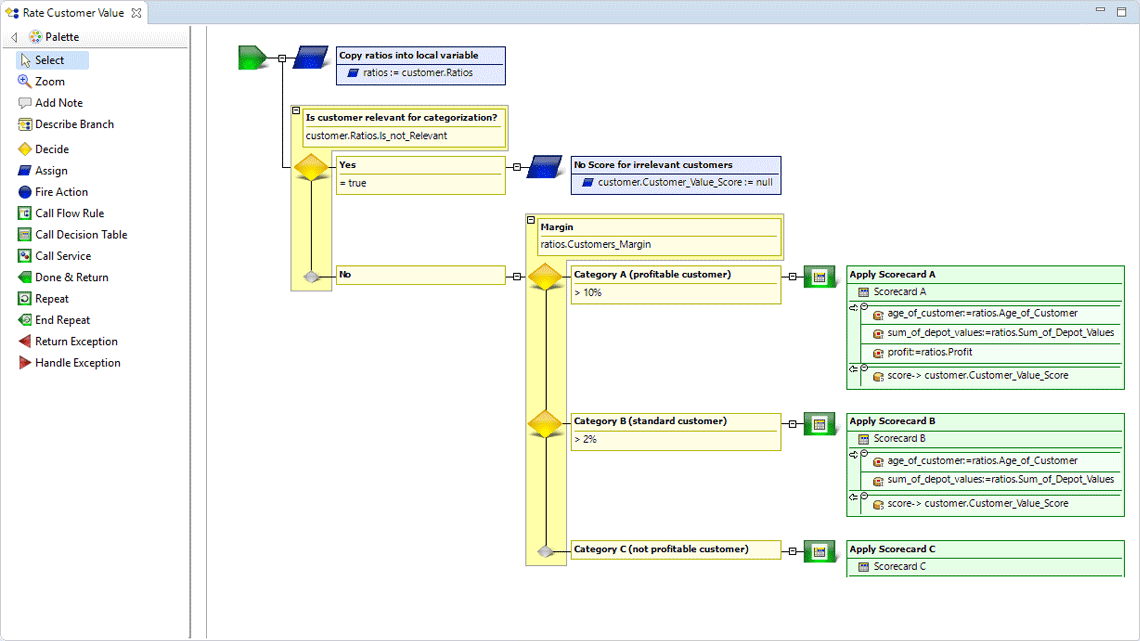
Information is collected in the form of rules and stored in a database. The engine picks rules according to conditions set and runs them based on the queries provided. If the rules match the requirements, then the engine executes the corresponding action and returns a solution.
In the image above, the rule-based engine queries the “Customers. Margin” variable and selects different actions depending on the variable’s value, such as applying a specific scorecard. The elements of this decision model can be assembled by mouse and customized by double-click.
Instead of just reading the content of a specific variable, a machine learning component can be queried to determine the probability that the customer will repay his loan on time. Depending on the result, the rule then performs various actions.
In the ACTICO Platform, business users create rules by dragging the elements of a business rule from a list to the work plane, linking them to existing features, and customizing the elements via detail settings. To do this, they enter assignments to variables or define threshold values for branching. Alternatively, rules are also described as decision tables. These allow different cases to be managed very compactly and clearly.
A Business Rules Management System (BRMS) tool is a software application used to define, deploy, execute, monitor, and manage business rules and decision logic. A BRMS automates business rules and decision-making in an organization’s business processes. In addition, it can link different technology solutions to perform the required functions.
The BRMS consists of:
Many applications have all their business logic within the program’s code, making maintenance, analysis, and optimization complicated, time-consuming, and cost-intensive. In addition, this setup makes the rapid implementation of changes nearly impossible.
A BRMS helps companies to separate their rule-based business logic from the rest of the application’s logic. This separation gives non-IT users capabilities to model, maintain, and optimize the business rules logic and make changes without interfering with the application’s processes.
Users can then test the rules by creating input values as test cases, specifying the expected results, and executing the rules. If the results do not match the specifications, users can easily trace the execution of the rule and thus find and fix the reason for the deviation.
A business rule is a set of conditions that define specific actions within a business context. For example, in programming, a business rule refers to the portion of your application that represents the core functionality of your application and how it works.
Often confused with business logic, the two differ because business logic is responsible for encoding business rules into the software program. In contrast, the business rule asserts and defines the constraints, processes, or operations that apply to a company.
Business rules are formally written as policies or informal practices kept among employees and only known through verbal interactions.
The best practice is to document business rules to improve communication, legal compliance and ensure uniformity with information shared across the organization.
Automating decisions leads to improved results, lower risk, and reduced likelihood of human error. A decision platform like ACTICO decentralizes rules from a program’s code by centralizing logic for speed and decision consistency. In addition, it allows business experts and non-technical users (rather than just IT) to create the logic.
Our software combines rule-based technology and AI to help organizations process large amounts of data and make operational decisions in real-time.
eBook
This eBook addresses the most important aspects and questions from a Gartner report on this subject and provides the right answers.
You may also be interested in:
Blog
FIU Reporting: Why Compliance Teams Are Getting Nervous – and How GenAI Can Help
Suspicious activity reports must be filed via goAML — incomplete or delayed submissions are no longer tolerated.
Financial Institutions/FinTech
Brochure
FIU Reporting with GenAI Support – Act promptly in cases of suspected money laundering
Detect money laundering, submit reports via goAML, benefit from generative AI: ACTICO Anti-Money Laundering and FIU Reporting software.
Anti-Money Laundering
Financial Institutions/FinTech
Live Event
ACTICO at Future Compliance 2026: Boosting efficiency in suspicious activity reporting with GenAI
ACTICO at Future Compliance | March 25, 2026 | Zurich: Discover the latest AI trends in suspicious activity reporting to MROS.
Anti-Money Laundering FIU Reporting
Financial Institutions/FinTech
Webinar
Anti-Money Laundering in Life Insurance: The EU AML Package is Coming. 2027 Is Closer Than You Think.
Why must life insurers fundamentally strengthen their anti-money laundering framework from 2027? The EU AML Package requires more robust IT systems. Watch the webinar.
Anti-Money Laundering
Financial Institutions/FinTech
Newsletter
Regular News and Updates
Decision Management Platform
Compliance
Resources
You are currently viewing a placeholder content from Wistia. To access the actual content, click the button below. Please note that doing so will share data with third-party providers.
More Information