



My impression is that ACTICO has delivered an all-round trouble free package. We are 100 percent convinced that we’ve made the right choice with the customer screening software and ACTICO as a partner.
The project manager of R+V Insurance (Germany)










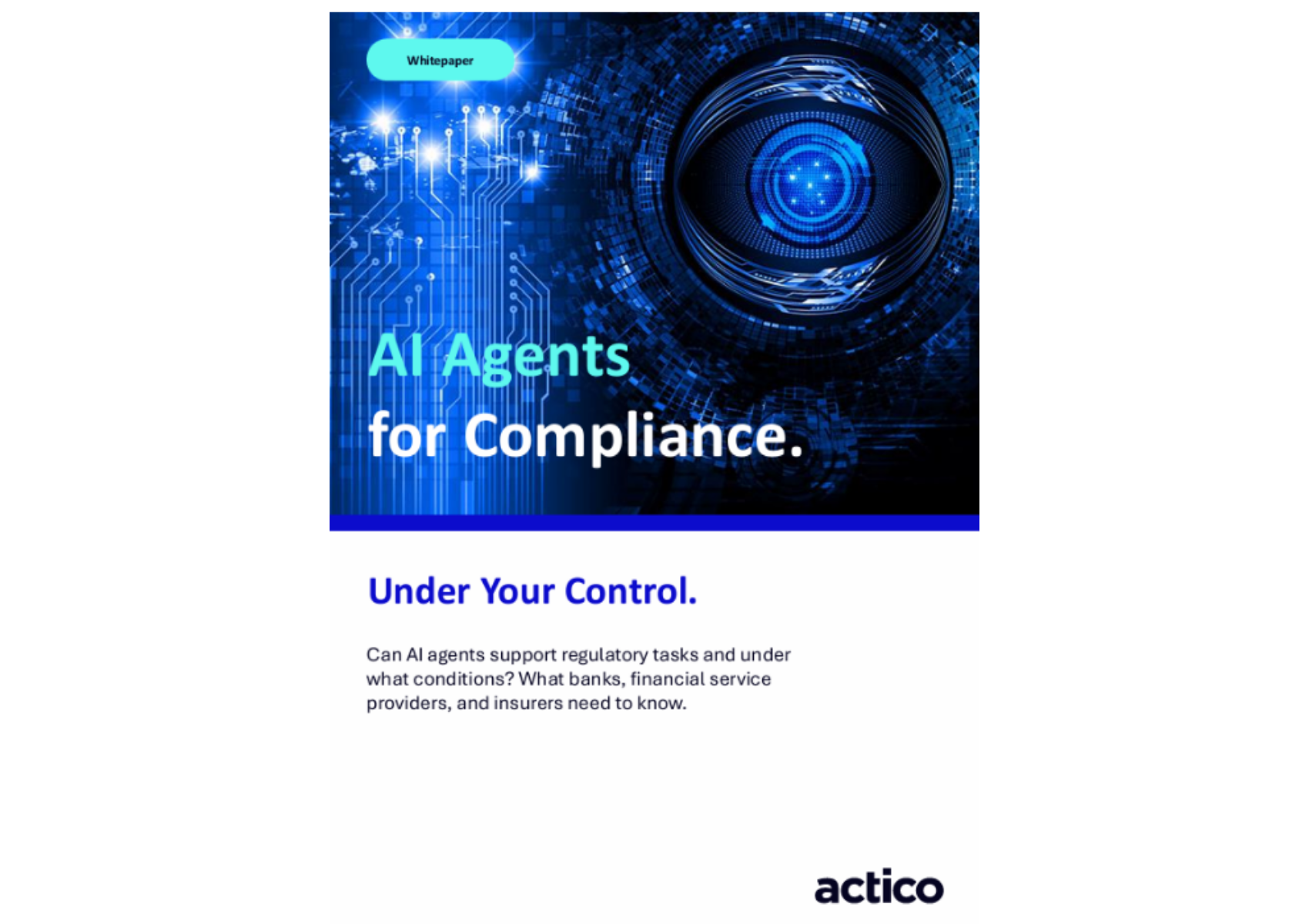
AI agents are the next automation step for banks and insurers. But strict governance applies — not only to the agents, but also to the large language models they use and where data is hoste (data sovereignty).
The whitepaper “AI Agents for Compliance” shows how AI agents support adverse media screening within ACTICO Compliance Solutions — with clear benefits for compliance teams.
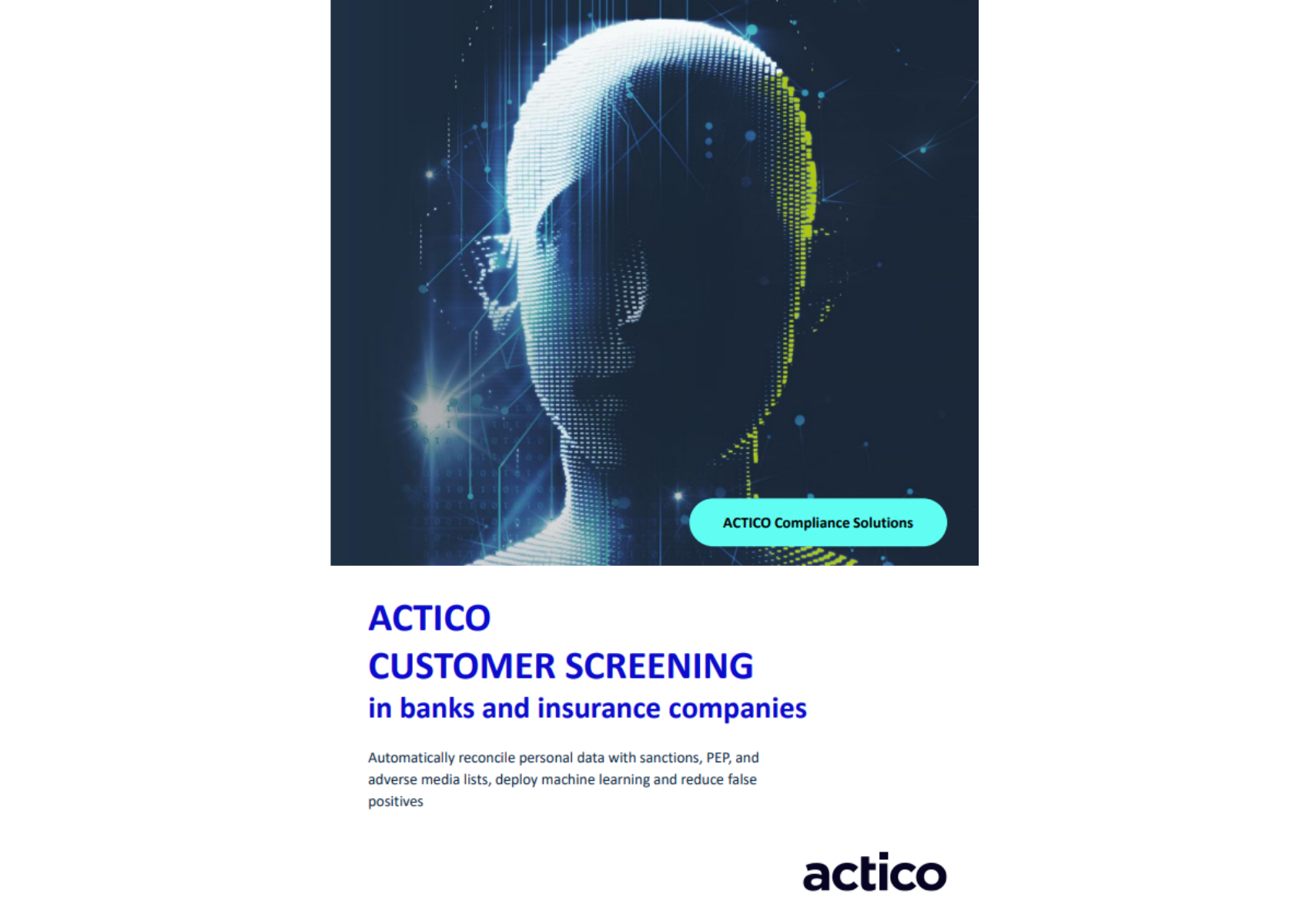
Banks and insurers screen customers against sanctions, PEP, and adverse media lists with ACTICO Customer Screening.
Machine learning reduces false positives. Flexible configuration adapts screening to individual requirements. Integrated case management supports efficient decisions.
Every step is documented, traceable, and audit-ready.
Why is it so important for compliance officers in the financial and insurance industry to reduce false positives in sanctions and PEP screening?
Compliance professionals need to make critical decisions: Is a hit resulting from the matching of customer data with sanctions, PEP, or adverse media lists a genuine risk — or just a false positive?
What compliance teams need is software that works quickly, precisely, and with the right level of caution: not too strict, to avoid unnecessary disruptions, and not too lenient, to ensure the organisation remains on solid legal ground.
ACTICO Customer Screening strikes that balance. It helps institutions meet regulatory due diligence obligations reliably, while also enabling them to work efficiently and cost-effectively.
How can banks and insurers configure their sanctions screening to minimise false positives?
False positives can be significantly reduced once the screening logic is tailored to the specific risk profile and operational needs of the bank or insurance company. This is achieved, for example, by using pre-filters that exclude irrelevant entries from the screening lists right from the start. It is also helpful to reflect the institution’s individual risk classification, allowing the system to apply different thresholds or rules depending on the defined risk level.
What types of customer screening are available, and how does the software typically perform these checks?
ACTICO Customer Screening supports both ongoing monitoring—for regular reviews of the customer base—and event-driven screening, such as during onboarding processes.
The software checks for name similarities, aliases, alternate spellings, dates of birth, and country information (such as nationality or country of residence). When potential matches are found, they are flagged as hits. These hits are then reviewed and documented in a dedicated case management system.
An intelligent whitelisting function ensures that already reviewed cases are not repeatedly flagged—unless relevant changes occur either in the customer data or in the screening lists.
What methods does ACTICO Customer Screening use to reduce false positive rates when matching customer data against sanctions lists?
ACTICO Customer Screening offers a screening simulation feature that provides statistical insights to help fine-tune the configuration — without affecting productive data. Once optimised, the final configuration can be transferred to the live system.
What does fuzzy matching mean in the context of sanctions screening for banks and insurers?
Fuzzy matching refers to approximate or non-exact matching — meaning that hits can still be found even when names are spelled incorrectly or differently.
ACTICO Customer Screening uses highly precise fuzzy matching to ensure that all relevant information is considered for every customer, at any time. The software connects to all relevant systems and databases — such as onboarding platforms or core banking systems — to maintain full visibility across the customer base.
It also stays up to date automatically by regularly importing the latest versions of sanctions lists, PEP lists, and adverse media data. This ensures that all screenings are performed using the most current information.
And because ACTICO Customer Screening is context-aware, it can detect attempts to bypass screening — such as by using alternative spellings or aliases. Even when fraudsters try to trick the system, ACTICO Customer Screening is ready.
Why are AI agents particularly well suited to adverse media research?
AI agents are well suited to compliance processes that involve unstructured information and extensive research. One example is the assessment of negative news, or adverse media, in ACTICO Customer Screening.
ACTICO brings AI agents into adverse media screening in a controlled way. The agents support time-intensive preparatory work such as research, analysis and documentation. Governance, roles and review paths remain embedded in the ACTICO Compliance platform, while the final decision stays with the compliance expert.
Institutions also remain in control of which language model the agents use and where that model runs.
Why is it safer to use AI agents in a controlled manner for adverse media screening?
If search queries are submitted to search engines without appropriate controls, they may reveal information about ongoing customer reviews, business relationships, or compliance investigations. Greater control can be achieved by integrating external sources through defined technical interfaces. This allows search queries, access, and data flows to be monitored and controlled, while also enabling better integration with existing governance and security requirements. ACTICO Customer Screening brings AI agents securely into the compliance process.
How does an AI agent work in ACTICO’s adverse media screening?
In ACTICO Customer Screening, an AI agent automatically identifies pending cases and retrieves relevant customer data via an interface.
Instead of conducting manual web searches, the agent initiates targeted queries against sources predefined by the financial institution. However, an AI agent does more than simply gather information—it processes it intelligently: The agent analyzes the results for regulatory relevance, assesses risk indicators, and prepares a summary presenting all relevant findings, citing the sources, and explaining why a case may represent a risk.
My impression is that ACTICO has delivered an all-round trouble free package. We are 100 percent convinced that we’ve made the right choice with the customer screening software and ACTICO as a partner.
The project manager of R+V Insurance (Germany)
ACTICO has consistently been recognized by customers and analysts as a leading provider of solutions for Compliance, Asset Administration, and Credit Risk Management, as well as Advanced Decision Automation Technology.






In the “Watchlist and Adverse Media Monitoring Solutions, 2026” report, ACTICO stands out in two categories: As a Category Leader in both Adverse Media Monitoring and Name & Transaction Screening, ACTICO achieved top ratings across all evaluation criteria.
You may also be interested in:

Podcast
“Sovereignty Means Being Able to Change Course” – A Conversation with Manfred Beckers
Digital sovereignty in finance: Manfred Beckers discusses cloud dependencies, DORA, exit strategies and maintaining the ability to adapt.
Compliance

News
Chartis Research Again Names ACTICO a Category Leader for AML Transaction Monitoring 2026
ACTICO has again been named a Category Leader in the Chartis RiskTech Quadrant® for AML Transaction Monitoring Solutions 2026. The assessment recognizes ACTICO’s strengths in risk typology modeling, analytical modeling, model validation, workflow automation, and AI-powered compliance.
Anti-Money Laundering
Financial Institutions/FinTech, Insurance
Awards & Recognitions
News
ACTICO announces it has joined forces with Axe Finance, a global provider of credit and risk management software
ACTICO announces that it has joined forces with Axe Finance, a UK-based provider of credit and risk management software. The deal is supported by Keensight Capital, one of the leading private equity managers dedicated to pan-European Growth Buyout investments.

Webinar On-Demand
Update on AML Requirements for Insurers: what you need to do now to be ready by July 2027.
AML update for insurers: What needs to be done by July 2027 regarding KYC, risk assessment and transaction monitoring? Including practical insights. Watch the webinar.
Anti-Money Laundering
Insurance
Newsletter
Regular News and Updates
Compliance
Asset Administration
Credit Risk
Decision Management
Resources
You are currently viewing a placeholder content from Hubspot Embedded Content. To access the actual content, click the button below. Please note that doing so will share data with third-party providers.
More InformationYou are currently viewing a placeholder content from HubSpot. To access the actual content, click the button below. Please note that doing so will share data with third-party providers.
More InformationYou are currently viewing a placeholder content from Hubspot Meetings. To access the actual content, click the button below. Please note that doing so will share data with third-party providers.
More InformationYou are currently viewing a placeholder content from Wistia. To access the actual content, click the button below. Please note that doing so will share data with third-party providers.
More Information