
Brochure
Deadline 10 July 2027: The EU AML Package Hits Insurers Hard
Anti-money laundering in insurance must change significantly due to the EU AML package: fewer manual processes, more automation.
Anti-Money Laundering
Insurance


07.04.2020|

Over the past two decades, the compliance function has gained in importance for banks. This is partially against a backdrop of numerous money-laundering scandals and embargo/sanction regimes. In an attempt to prevent money laundering and the financing of terrorism, various quantitative methods have been established, especially the risk-based approach that was recommended by the Financial Action Task Force (FATF).
For this risk-based approach, the use of advanced methods and analysis technologies such as machine learning are on the rise. Here, we delve into the most suited procedures for the analysis of customer data and what benefits can banks and insurance companies derive from these.
There are several machine learning procedures that are appropriate for compliance. Supervised Learning with Random Forests has proven to be a method that is easy to use and understand. At the same time, it offers high quality results.
ACTICO Machine Learning allows the Compliance officers to classify the test results in individual cases, so that the random-forest algorithm is automatically optimized. With their feedback, they improve the future classification. The best results are therefore, achieved when compliance and machine learning experts cooperate and train models. As a result, compliance departments save up to 57 percent of clarifications.
Every bank and insurance company uses KYC software to check new and existing customers. This software matches customer data with entries in the sanctions list, the so-called ‘true positives’. But, the exercise also generates false positives, i.e. hits that do not match but are erroneously shown by the system. From a regulatory perspective, this is correct. However, compliance staff must invest a lot of work in clarifying these false positives, even though they are not posing any risk for the business. The fewer false positives there are, the less time and effort compliance staff have to spend on these clarifications. This is where machine learning comes in.
Data analyses have shown that the cut-off ratio is up to 43 percent. This means that 57 percent of the hits found are highly unlikely to represent a risk and therefore do not need to be clarified. Machine Learning is included as a component in the ACTICO Compliance Suite and predicts the probability with which a person represents a risk.
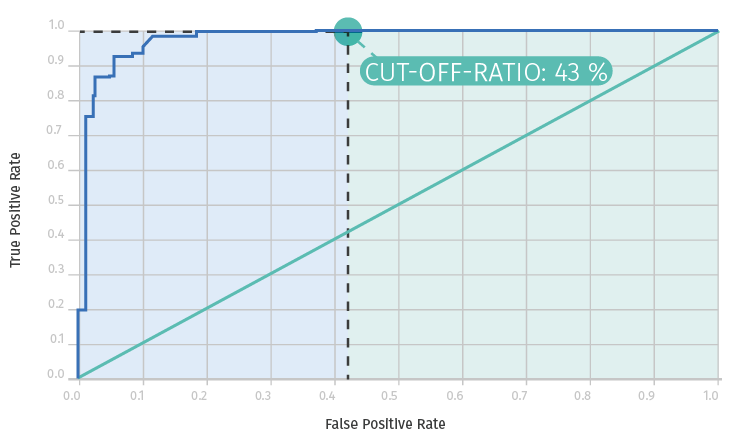
Machine Learning achieves a prioritization of hits, i.e. matches found during the name check. The identification of false positives and the exclusion of these non-relevant hits considerably reduces the follow-up effort and relieves compliance staff.
Whitepaper
Would you like more background information? Read the facts in the new whitepaper.
You may also be interested in:
Brochure
Deadline 10 July 2027: The EU AML Package Hits Insurers Hard
Anti-money laundering in insurance must change significantly due to the EU AML package: fewer manual processes, more automation.
Anti-Money Laundering
Insurance

Webinar On-Demand
Anti-Money Laundering in Life Insurance: The EU AML Package is Coming. 2027 Is Closer Than You Think.
Why must life insurers fundamentally strengthen their anti-money laundering framework from 2027? The EU AML Package requires more robust IT systems. Watch the webinar.
Anti-Money Laundering
Financial Institutions/FinTech
Webinar On-Demand
Agentic AI in Action: How AI Agents Are Redefining Key Processes in Banking and Financial Services
Watch the Webinar to explore real-world agentic AI use cases in banking and financial services — plus a focused deep dive into commercial credit risk assessment with a live demo and sample ROI calculation.
Credit Risk Management
AI

Blog
FIU Reporting: Why Compliance Teams Are Getting Nervous – and How GenAI Can Help
FIUs and Switzerland’s MROS require financial institutions to submit SARs via goAML — they do not tolerate incomplete or delayed reports.
Financial Institutions/FinTech
Newsletter
Regular News and Updates
Decision Management Platform
Compliance
Resources
You are currently viewing a placeholder content from HubSpot. To access the actual content, click the button below. Please note that doing so will share data with third-party providers.
More InformationYou are currently viewing a placeholder content from Hubspot Meetings. To access the actual content, click the button below. Please note that doing so will share data with third-party providers.
More InformationYou are currently viewing a placeholder content from Wistia. To access the actual content, click the button below. Please note that doing so will share data with third-party providers.
More Information