
Podcast
“Sovereignty Means Being Able to Change Course” – A Conversation with Manfred Beckers
Digital sovereignty in finance: Manfred Beckers discusses cloud dependencies, DORA, exit strategies and maintaining the ability to adapt.
Compliance


09.01.2025|
Day in and day out, banks and financial service providers work to keep their customers safe and secure. A key part of this effort involves analyzing customer identities and assessing risks to prevent money laundering, fraud, and other financial crimes. This means checking customer data against sanctions lists, PEP (Politically Exposed Persons) lists, and adverse media, as well as any custom watchlists. Customer screening is an integral part of the Know Your Customer (KYC) process, ensuring thorough due diligence.
Customer screening has gained new momentum with instant payments. However, daily screening of customer data comes with its own challenges.
The Instant Payment Regulation (IPR) mandates that payment service providers (PSPs) be equipped to handle real-time transfers starting in January 2025, provided they check customer data against sanctions lists at least once daily.
Customers expect their PSP to provide reliable instant payments. Any disruptions can lead to significant frustration. The challenge lies in finding the right balance between meeting customer expectations and ensuring institutional security.

Are you a compliance professional in a bank or insurance? Then you certainly wish to have as few false positives as possible when screening your client base against sanctions and PEP lists, adverse media lists and internal company lists.
Automatically reconcile customer data with sanctions, PEP, and adverse media lists, deploy machine learning and reduce false positives.
Over and above instant payments alone though, screening customers is important for other reasons. It’s a key way to help prevent money laundering, for example. Companies that are regulated must check customer data when they first start doing business with someone, then regularly screen the entire customer base against sanctions and PEP lists.
This isn’t new, but customer screening is now a big part of making compliance more efficient. If the software is set up right, it’ll show as few false positives as possible, so compliance teams can focus on the real cases, the true positives. But how do they get there?
Regulated entities have to scrutinise new and existing customers as part of their Customer Due Diligence (CDD) process. This multi-faceted approach encompasses Know Your Customer (KYC) identification and regular cross-checking of customer data against sanctions, PEP and adverse media lists.
The Instant Payment Regulation IPR mandates that payment service providers screen their customers against these lists at least once per day. This ensures that clients sending or receiving real-time transfers aren’t flagged on any watchlists.
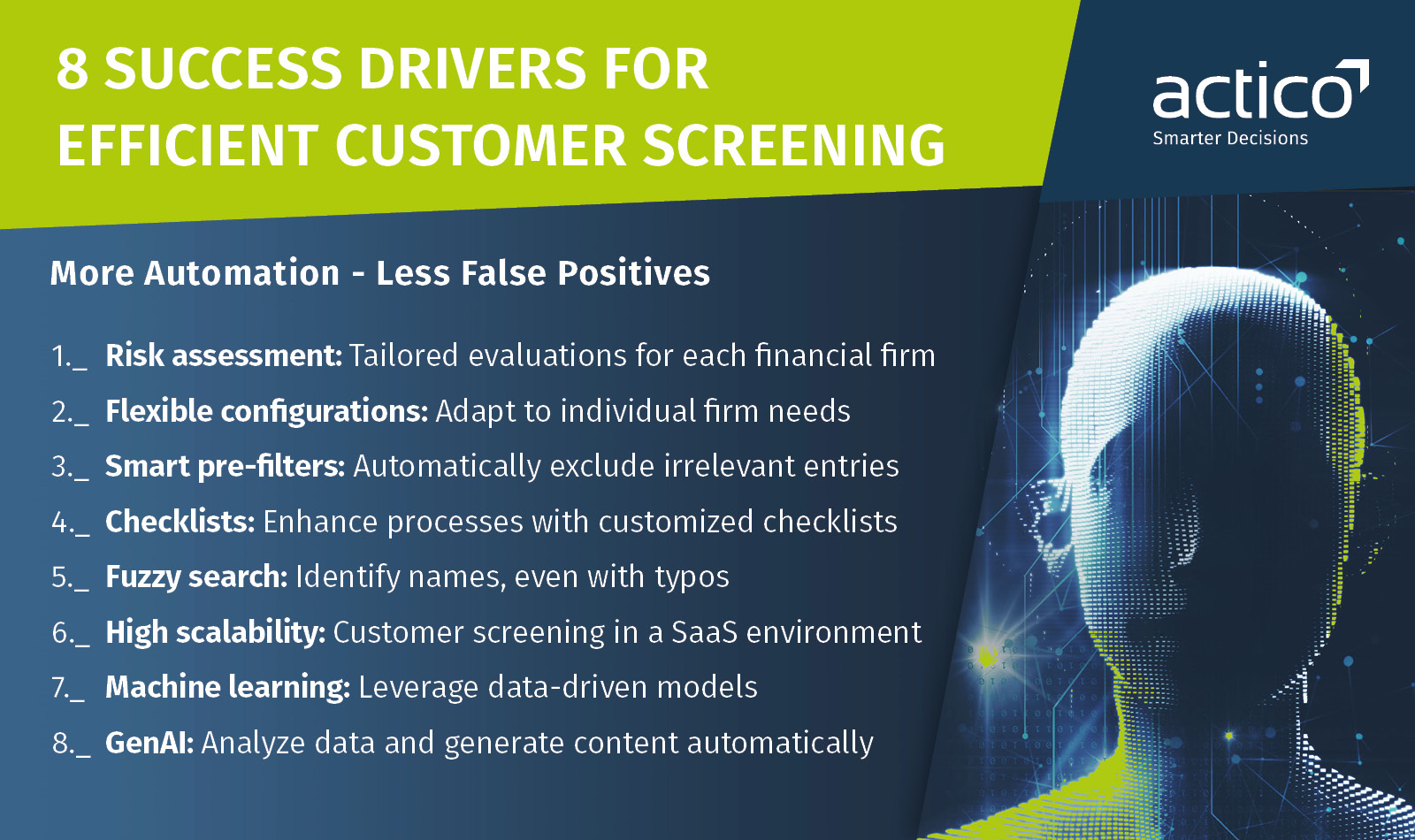
The challenge for payment providers? Manual checks simply aren’t feasible with instant payments. Instead, the payment system must automatically halt transactions the moment a customer’s details match a sanctions list entry. False positives frustrate customers and create additional work for banks. The solution? Sophisticated algorithms, tailored configurations and ML models that dramatically reduce false positives.
Customer screening takes centre stage when it comes to instant payments and anti-money laundering. Get a robust screening system in place and you enhance efficiency, slash costs and bolster your competitive edge. The keys to success? Customer satisfaction, ironclad compliance risk management and the judicious deployment of compliance personnel.
You may also be interested in:
Podcast
“Sovereignty Means Being Able to Change Course” – A Conversation with Manfred Beckers
Digital sovereignty in finance: Manfred Beckers discusses cloud dependencies, DORA, exit strategies and maintaining the ability to adapt.
Compliance

News
Chartis Research Again Names ACTICO a Category Leader for AML Transaction Monitoring 2026
ACTICO has again been named a Category Leader in the Chartis RiskTech Quadrant® for AML Transaction Monitoring Solutions 2026. The assessment recognizes ACTICO’s strengths in risk typology modeling, analytical modeling, model validation, workflow automation, and AI-powered compliance.
Anti-Money Laundering
Financial Institutions/FinTech, Insurance
Awards & Recognitions
News
ACTICO announces it has joined forces with Axe Finance, a global provider of credit and risk management software
ACTICO announces that it has joined forces with Axe Finance, a UK-based provider of credit and risk management software. The deal is supported by Keensight Capital, one of the leading private equity managers dedicated to pan-European Growth Buyout investments.

Webinar
Update on AML Requirements for Insurers: what you need to do now to be ready by July 2027.
AML update for insurers: What needs to be done by July 2027 regarding KYC, risk assessment and transaction monitoring? Including practical insights. Watch the webinar.
Anti-Money Laundering
Insurance
Newsletter
Regular News and Updates
Decision Management Platform
Compliance
Resources
You are currently viewing a placeholder content from Hubspot Embedded Content. To access the actual content, click the button below. Please note that doing so will share data with third-party providers.
More InformationYou are currently viewing a placeholder content from HubSpot. To access the actual content, click the button below. Please note that doing so will share data with third-party providers.
More InformationYou are currently viewing a placeholder content from Hubspot Meetings. To access the actual content, click the button below. Please note that doing so will share data with third-party providers.
More InformationYou are currently viewing a placeholder content from Wistia. To access the actual content, click the button below. Please note that doing so will share data with third-party providers.
More Information