
Podcast
“Sovereignty Means Being Able to Change Course” – A Conversation with Manfred Beckers
Digital sovereignty in finance: Manfred Beckers discusses cloud dependencies, DORA, exit strategies and maintaining the ability to adapt.
Compliance


22.06.2021|

Checking customer data against sanctions and embargo lists costs money – but failing to detect a compliance risk can be even more expensive, resulting in severe penalties and reputational damage. What is to be done, particularly when financial regulators are constantly tightening the reins?
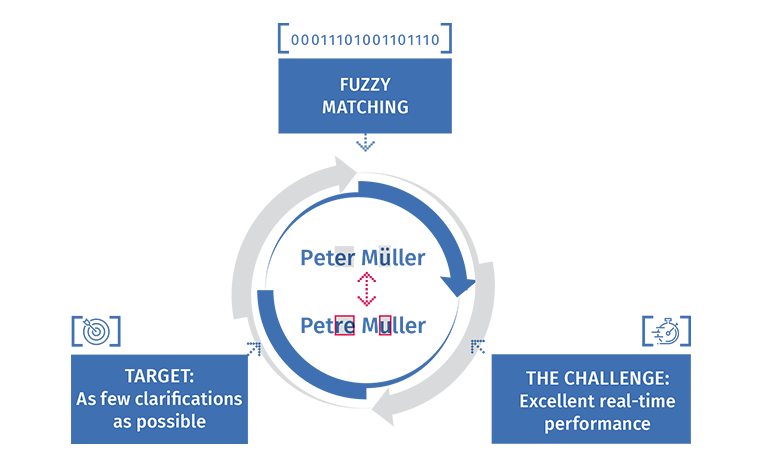
Financial regulators increasingly require the use of fuzzy matching. This means that it is still possible to identify risky transactions even if the name in the transaction does not exactly match the name on the sanctions list, perhaps due to typing errors or even the deliberate misspelling of names. The problem is that a fuzzy search always produces more hits than an exact search, which increases the workload of compliance teams.
Financial institutions find themselves caught between the conflicting priorities of effectiveness and efficiency. This means:
Whitepaper
Machine learning significantly improves existing systems by combining data knowledge and human expertise, and machine learning models can be trained and improved on an ongoing basis.
Discover the three stages of effectiveness and efficiency testing with machine learning.
Financial institutions are under extreme pressure to comply with regulatory frameworks. The work of compliance departments is dominated by the need to prevent financial crime. Payment screening has a vital role to play in this respect. It is a key component of risk management that protects financial institutions from legal consequences, penalties and damage to their reputation.
Real-time payments and other digital payment options mean that risk decisions have to be made faster than ever before. Banks have to strike a balance between due diligence, customer expectations and the cost situation.
During the screening process, the payment screening software checks payment data against sanctions lists, embargo lists and other blacklists. This data matching is based on criteria such as first and last name, company name, alias name, alternative spellings, countries involved, banks, BICs, accounts, amount, keywords and whitelist exceptions. Financial institutions are under increasing pressure to ensure their systems are both efficient and effective.
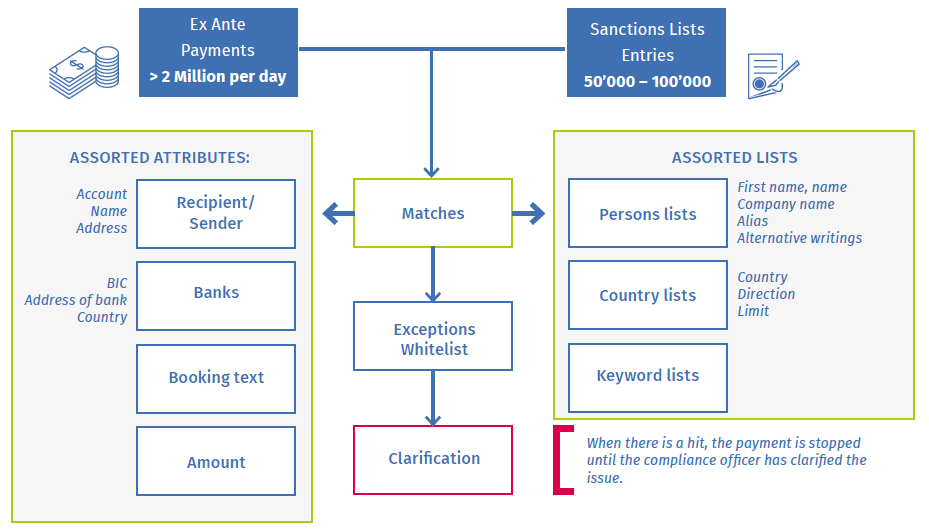
If a hit, i.e. a potential match to a sanctions list entry, is discovered during payment screening, this process has to be clarified manually. Banks can’t afford to miss anything – failure to spot a suspicious payment could entail serious legal and financial consequences.
Banks usually carry out effectiveness tests every year using predefined test cases. These check whether the system is identifying the hits it has to find in order to ensure compliance. These tests are usually done using test data rather than real data to avoid confidentiality issues.
They are normally conducted by independent third parties such as management consultancies and auditing firms. They use benchmarks from several institutions to compare a bank’s payment screening performance against that of their peers.
The efficiency test examines how much work a hit generates when screening a payment. Every hit has to be reviewed by a member of the compliance team, who decides whether the name that appears on the payment is actually the person on the sanctions list. The percentage of true positives, i.e. hits that represent a real threat, should be as high as possible. This is because unnecessary hits (false positives) increase the workload of compliance staff without posing an actual risk. The efficiency of a system depends on finding the fewest possible false positives.
The fact that sanctions lists are growing longer and banks are regularly screening transactions increases the likelihood of false positives, for example when customers have an identical or similar name. Processing every hit requires time and money, which is why banks are working hard to improve the efficiency of their payment screening systems.
Achieving the twin goals of effectiveness and efficiency in payment screening is rarely easy because it is always a trade-off between risk and cost. On the one hand, the system has to identify every risky transaction for compliance reasons. But on the other, banks want to save money by handling as few clarifications as possible.
Machine learning has delivered tangible results in practice, helping to achieve an optimal balance of effectiveness and efficiency. This is evident at VP Bank Group, which has reduced manual effort by around 50% using fuzzy matching.
Compliance officers often struggle with legacy compliance systems that lead to manual processes, generate high volumes of false positives, and offer rigid reporting. They would be more satisfied with a structured compliance management system that enables swift responses to regulatory changes, automates routine tasks, helps avoid reputational and financial penalties, and supports customer satisfaction.
The IT department recognises the benefits of adopting new technologies and is eager to leverage AI, cloud, and automation—advantages that legacy systems often fail to support. A common priority is migrating on-premise compliance applications to the cloud to optimise human resources. Security and high scalability are also key requirements.
Customers are increasingly communicating with their banks via digital channels, so they expect to have a fast and secure digital experience. This means that the payment screening system must be powerful enough to handle this shift in consumer behaviour and deliver the speed and reliability that is needed.
Fuzzy matching makes it possible to analyze transactions more effectively. It also identifies anomalies in the event that names are reversed, falsified or misspelled, a letter is added, abbreviations are used, etc. But there is another side to the coin: a fuzzy search always produces more hits than an exact search. Therefore, the screening system has to be intelligent enough to flag only risky payments (true positives) and keep false positives to a minimum in order to avoid unnecessary clarification costs.
You may also be interested in:
Podcast
“Sovereignty Means Being Able to Change Course” – A Conversation with Manfred Beckers
Digital sovereignty in finance: Manfred Beckers discusses cloud dependencies, DORA, exit strategies and maintaining the ability to adapt.
Compliance

News
Chartis Research Again Names ACTICO a Category Leader for AML Transaction Monitoring 2026
ACTICO has again been named a Category Leader in the Chartis RiskTech Quadrant® for AML Transaction Monitoring Solutions 2026. The assessment recognizes ACTICO’s strengths in risk typology modeling, analytical modeling, model validation, workflow automation, and AI-powered compliance.
Anti-Money Laundering
Financial Institutions/FinTech, Insurance
Awards & Recognitions
News
ACTICO announces it has joined forces with Axe Finance, a global provider of credit and risk management software
ACTICO announces that it has joined forces with Axe Finance, a UK-based provider of credit and risk management software. The deal is supported by Keensight Capital, one of the leading private equity managers dedicated to pan-European Growth Buyout investments.

Webinar On-Demand
Update on AML Requirements for Insurers: what you need to do now to be ready by July 2027.
AML update for insurers: What needs to be done by July 2027 regarding KYC, risk assessment and transaction monitoring? Including practical insights. Watch the webinar.
Anti-Money Laundering
Insurance
Newsletter
Regular News and Updates
Compliance
Asset Administration
Credit Risk
Decision Management
Resources
You are currently viewing a placeholder content from Hubspot Embedded Content. To access the actual content, click the button below. Please note that doing so will share data with third-party providers.
More InformationYou are currently viewing a placeholder content from HubSpot. To access the actual content, click the button below. Please note that doing so will share data with third-party providers.
More InformationYou are currently viewing a placeholder content from Hubspot Meetings. To access the actual content, click the button below. Please note that doing so will share data with third-party providers.
More InformationYou are currently viewing a placeholder content from Wistia. To access the actual content, click the button below. Please note that doing so will share data with third-party providers.
More Information