
Podcast
“Sovereignty Means Being Able to Change Course” – A Conversation with Manfred Beckers
Digital sovereignty in finance: Manfred Beckers discusses cloud dependencies, DORA, exit strategies and maintaining the ability to adapt.
Compliance


10.03.2026|

“Complete” and “promptly” – these terms define the framework for every suspicious activity report submitted to the FIU. Yet speed alone is not enough. The FIU expects substantial, comprehensible and structured reports in cases of suspected money laundering.
Incomplete information or reports submitted on insufficient grounds are increasingly criticised. The FATF also warns against over-reporting. For compliance teams, this creates a balancing act: report – but only on a sound factual basis. Act quickly – but ensure completeness. Be precise – and technically compliant with goAML standards.
The time has come to generate FIU reports directly from AML systems and draw on generative AI when drafting case justifications.
The path to a suspicious activity report is clearly structured:
In practice, however, this is where the real effort begins. Data is held across multiple systems. Different departments must provide information. Cases must be described clearly and accurately – all while the clock is ticking.
The expectations are high: complete, structured, technically compliant – and substantively justified. GenAI can help.
GenAI helps to formulate complex cases in a structured and understandable manner – even under time pressure. It is based on large language models (LLMs) trained on extensive text data. It structures information, makes suggestions and drafts texts. This makes it particularly effective when describing facts to justify a suspicion of money laundering.
In an ideal world, the AI processes data from the AML system, interprets transaction patterns, identifies reasons for unusual behaviour, recognises relationships between involved parties, and formulates a clear and concise justification for the FIU.
GenAI within ACTICO FIU Reporting supports compliance teams in acting quickly and ensuring that all relevant aspects are considered.
Complete, high-quality reports supported by GenAI reduce time expenditure and minimise the risk of errors. Nevertheless, the final decision remains with human experts, following the “human-in-the-loop” principle. Submission of the FIU report therefore only takes place following explicit approval by AML specialists.
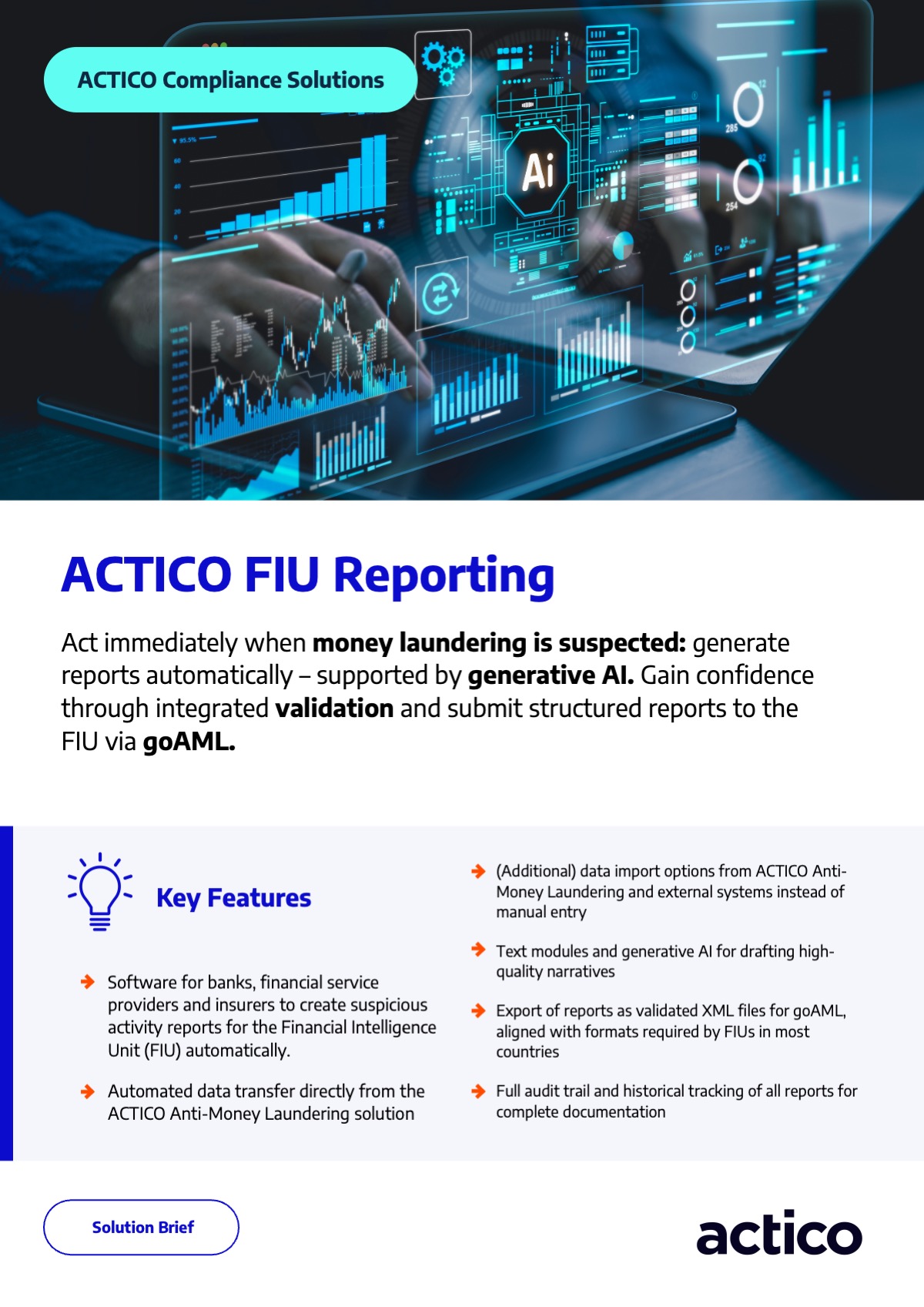
FIU Reporting via goAML
Submitting a prompt suspicious activity report requires a structured process – from automated data transfer from the AML system, to the use of generative AI (GenAI), and comprehensive data validation prior to submission.
FIU reports operate within a clearly defined regulatory framework – one that leaves less room for interpretation than before.
Section 43 (1) of the German Anti-Money Laundering Act (GWG) requires a suspicious activity report to be submitted promptly. According to Section 121 of the German Civil Code (BGB), this means “without culpable delay”. Guidance issued by the FIU and BaFin specifies that this generally means on the same day or, at the latest, the following working day. Germany’s financial watchdog BaFin and the FIU explicitly warn against reports submitted without sufficient grounds. Assumptions or unreviewed alerts from transaction monitoring systems are not sufficient. Every report must be based on concrete indications and must be properly substantiated.
The German Money Laundering Reporting Regulation (GwGMeldV) specifies the information required pursuant to Sections 43 and 44 GWG. The FIU aims to analyse suspicious activity reports more quickly, effectively and consistently.
Banks should avoid over-reporting or defensive reporting. The FATF made this clear in its latest Mutual Evaluation Report on Germany. The aim is to prevent the number of reports from rising unnecessarily and to avoid burdening the FIU with irrelevant submissions.
This puts compliance teams in a demanding position: report swiftly – but only on a solid evidential basis. Submit structured information, without generating unnecessary reports.
In Switzerland, Article 9 of the Anti-Money Laundering Act requires financial intermediaries to submit reports to MROS via goAML without delay. The Association for Quality Assurance of Financial Services specifies that reports must meet the requirements of Article 3 MGwV and present the grounds for suspicion as precisely as possible. In Liechtenstein and, prospectively, under the EU-wide framework of AMLA, comparable standards apply.
What’s next? The role of AMLA
AMLA will drive further harmonisation of supervisory standards across Europe. From 2027, it will establish a binding legal framework defining when a suspicion is reportable. Reports will continue to be submitted to the respective national FIU, but harmonised definitions will increase clarity and comparability across the EU. AMLA will also strengthen cooperation between national FIUs through joint analyses in cross-border cases. This will help identify complex money laundering patterns more quickly and ensure they are forwarded to the competent authorities.
The direction of travel is clear:
The FIU, MROS and AMLA are all tightening their approach. Suspicious activity reports submitted via goAML are expected to be standardised and of high quality – and filed promptly, as soon as a potential money laundering case is identified.
FIU Reporting Creates Nervousness in Compliance Teams
Compliance professionals are acutely aware that incomplete or delayed reports do not go unnoticed. In the worst case, regulatory action or financial penalties may follow.
Greater Substance – No FIU Reports Without Grounds
The expectation of substance has risen sharply: no reports on insufficient grounds, no over-reporting – but well-founded and structured suspicious activity reports.
Teams must gather data from multiple systems, formulate cases precisely and submit them in full compliance with formal requirements – all while the clock is ticking.
Where Does Support Come From?
Streamlining processes and transferring data automatically from AML systems into FIU reporting reduces the risk of errors. Automation ensures structure, completeness and speed. Pre-submission validation confirms that all mandatory fields have been completed.
Money Laundering Reporting Officers Should Not Have to Reinvent the Wheel
Drafting a coherent case description is often the most demanding part of an FIU report. Why does a reportable suspicion exist? Which facts substantiate the assessment?
Generative AI provides targeted support: generating context-based text suggestions, structuring complex information and assisting with the formulation of the grounds for suspicion.
Human-in-the-Loop: The Final Decision Lies with the Individual
Money laundering reporting officers can draw on well-founded, context-appropriate wording – for example, in cases involving unexplained cash deposits or suspected illegal gambling.
Maintaining the human-in-the-loop approach remains essential. The final decision on the content of a suspicious activity report must always rest with the responsible professional.
You may also be interested in:
Podcast
“Sovereignty Means Being Able to Change Course” – A Conversation with Manfred Beckers
Digital sovereignty in finance: Manfred Beckers discusses cloud dependencies, DORA, exit strategies and maintaining the ability to adapt.
Compliance

News
Chartis Research Again Names ACTICO a Category Leader for AML Transaction Monitoring 2026
ACTICO has again been named a Category Leader in the Chartis RiskTech Quadrant® for AML Transaction Monitoring Solutions 2026. The assessment recognizes ACTICO’s strengths in risk typology modeling, analytical modeling, model validation, workflow automation, and AI-powered compliance.
Anti-Money Laundering
Financial Institutions/FinTech, Insurance
Awards & Recognitions
News
ACTICO announces it has joined forces with Axe Finance, a global provider of credit and risk management software
ACTICO announces that it has joined forces with Axe Finance, a UK-based provider of credit and risk management software. The deal is supported by Keensight Capital, one of the leading private equity managers dedicated to pan-European Growth Buyout investments.

Webinar
Update on AML Requirements for Insurers: what you need to do now to be ready by July 2027.
AML update for insurers: What needs to be done by July 2027 regarding KYC, risk assessment and transaction monitoring? Including practical insights. Watch the webinar.
Anti-Money Laundering
Insurance
Newsletter
Regular News and Updates
Decision Management Platform
Compliance
Resources
You are currently viewing a placeholder content from Hubspot Embedded Content. To access the actual content, click the button below. Please note that doing so will share data with third-party providers.
More InformationYou are currently viewing a placeholder content from HubSpot. To access the actual content, click the button below. Please note that doing so will share data with third-party providers.
More InformationYou are currently viewing a placeholder content from Hubspot Meetings. To access the actual content, click the button below. Please note that doing so will share data with third-party providers.
More InformationYou are currently viewing a placeholder content from Wistia. To access the actual content, click the button below. Please note that doing so will share data with third-party providers.
More Information