Actico_Element_16-9_Verauf eb-mb-rb_300

08.05.2025|

Why is the fight against money laundering in Switzerland an ongoing challenge?

  • Anti-Money Laundering
  • Financial Institutions/FinTech
  • Blog
The fight against money laundering in Switzerland will continue in 2025. The focus remains on transparency of legal entities and the identification of beneficial owners.
In addition, the number of suspicious activity reports is rising. This was highlighted by MROS in its latest annual report for 2024.
All stakeholders are therefore called upon to keep efficiency in mind. Advancing IT infrastructure and leveraging machine learning and generative AI offer the best opportunities to manage limited resources effectively.


Banks must Constantly Adapt to Revised or New AML Legislation

Changes to AML regulations in Switzerland have been introduced over recent years through different laws and international agreements:

ANTI-MONEY LAUNDERING & MACHINE LEARNING

Reduce false positives and minimize manual AML operations

ACTICO Anti Money Laundering is the Next Generation software to flag or detect conspicuous payments, behavioural patterns and customer relationships. It helps banks, insurers and financial services providers ensure AML compliance, automatically check customers, business relationships and transactions, and recognise potential money laundering.

Download Brochure 

Reports of Suspected Money Laundering Are on the Up: A Problem for Banks and MROS

The volume of incoming SARs continued to increase in 2024: Financial intermediaries sent MROS (Swiss Money Laundering Reporting Office) a total of 15,141 suspicious activity reports (SARs). This represents an increase of 27.5% compared with the previous year (2023: 11,876). On average, MROS received 59 SARs per working day. 92,3 per cent of money laundering reports in 2024 came from the financial sector.

FATF recognizes Switzerland’s progress in strengthening its AML/CTF measures

The fourth FATF Enhanced Follow-up Report published in October 2023 analyses the progress assessed to remedy some of the technical compliance shortcomings identified in its MER. Eight of the 40 recommendations are now marked as “compliant” (C). 29 as largely compliant (PC). Three recommendations are classified as “partially compliant” (PC).

In October 2024, the FATF concluded the fourth round of mutual country evaluations. This peer-to-peer evaluation analysed the measures taken by over 200 member countries to tackle financial crime, terrorist financing and proliferation. The Mutual Evaluation Reports (MER) analyse the respective progress made by each country, but also reveal their weaknesses.

With the start of the 5th round of evaluations, Switzerland and thus MROS also began the preparatory work for the evaluation of Switzerland. The State Secretariat for International Finance (SIF) has the lead in coordinating these activities.

The next FATF mutual evaluation of Switzerland is expected to take place in 2027/2028.


Basel Anti-Money Laundering Index: Assessing Money Laundering Risks Worldwide

The Basel AML Index measures the risk of money laundering and related financial crimes in countries and jurisdictions around the world. It uses a composite methodology, with 17 indicators in five domains in line with key factors considered to contribute to a high risk.

Out of 164 countries, San Marino received the highest rating in 2024. At the very bottom, in position 164, is Myanmar. Switzerland ranks 124th, while Liechtenstein ranks 139th.
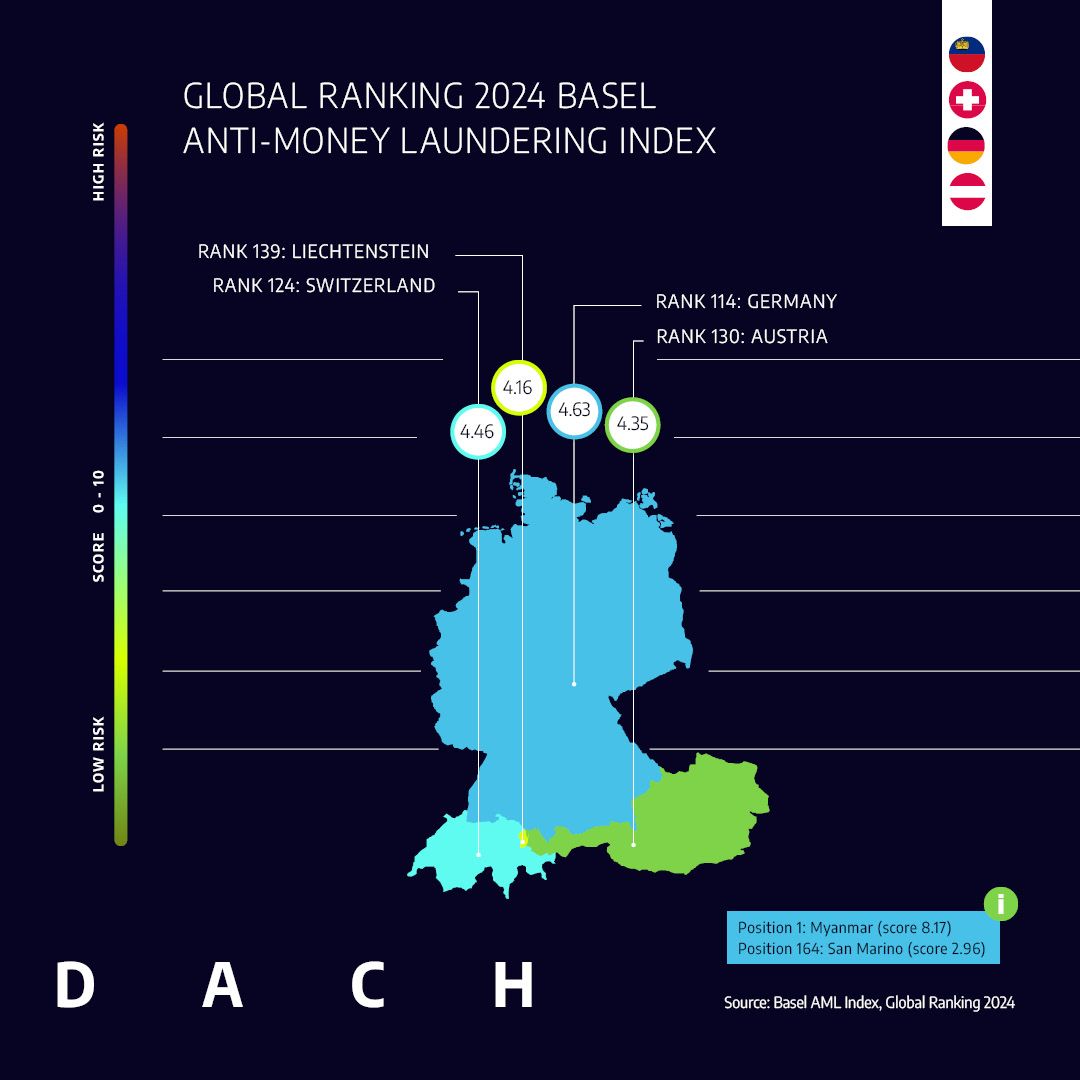
 

ACTICO Basel Index 2024

Five ways financial service providers can prevent money laundering more effectively

Regardless of the place of business, the following points can be helpful for financial service providers to improve their anti-money laundering activities.

  1. FIU Reporting for goAML: Generate suspicious activity reports (SARs) directly from the AML system, auto-fill report data, and upload via XML.
  2. Clearly state current persons and entities of interest following updated sanctions PEP and embargo lists
  3. Integrate machine learning methods, e.g. to help reconcile data with sanctions lists and monitor embargos during payment transactions
  4. Use machine learning insights to reduce the rate of false positives, verify previous clarifications and streamline clarification process to cut costs
  5. Conduct efficiency and effectiveness tests as part of payment monitoring

Retail bank uses machine learning to save around 40 per cent of false positives in money laundering detection

In collaboration with ACTICO, a retail bank rubber-stamped the potential of AI as a means of reducing false positives in the battle against money laundering. The bank used a base of almost 12,000 historical money laundering anomalies to train a machine learning-model to predict which would require further investigation. The model learns from transaction and customer data for which the anomaly was flagged, as well as whether the anomaly required investigation in greater depth to clarify. A validation dataset demonstrated the potential to eliminate around 40 per cent of false positive cases, without overlooking any SAR which would otherwise be notifiable to the financial regulator.

Conclusion

Changes to anti-money laundering laws often plunge banks into extensive adjustment processes. These are not easy to manage, especially given the shortage of human resources.

On top of that, banks are particularly cost-conscious in areas that do not generate revenue. As a result, they are scrutinising their processes more closely and exploring ways to improve efficiency. This also requires a willingness to embrace change.

Machine learning – a component of artificial intelligence – and generative AI (genAI) offer significant potential for cost reduction. High on the priority list are reducing false positives with machine learning and using genAI to support the reporting of suspected money laundering cases to MROS.